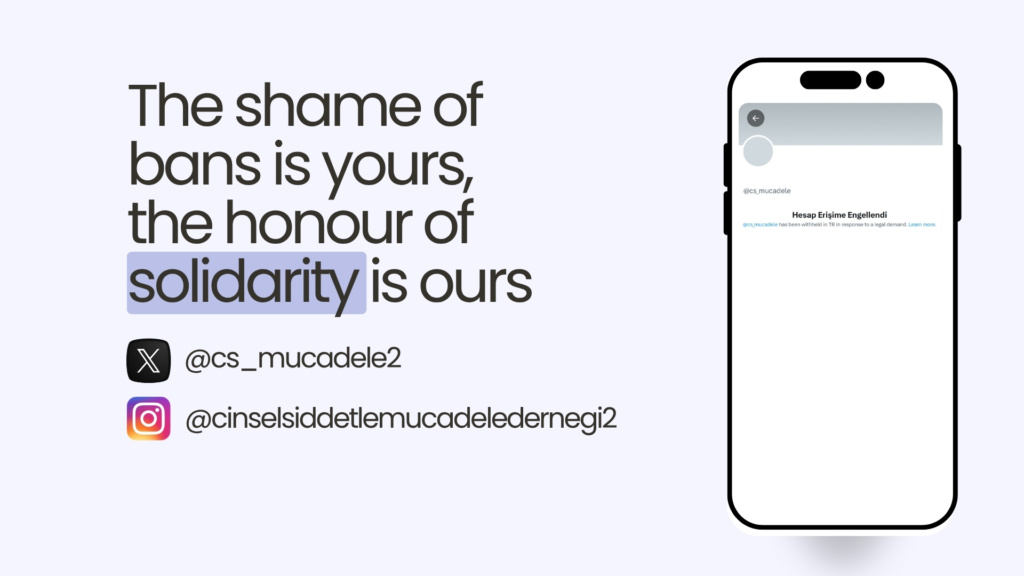
During Pride Month, we are witnessing yet another example of policies targeting LGBTQI+ people, feminists, and human rights defenders. On the evening of June 19th, our association’s X account was blocked from access in Türkiye by a decision of the Information and Communication Technologies Authority (BTK), reportedly on the grounds that our posts contained the term “LGBTQI+”. Many queer feminist organisations and collectives have been subjected to similar restrictions.
We do not view this decision merely as censorship of a social media account. Rather, we see it as a digital manifestation of discriminatory policies that seek to erase the existence, visibility, and demands for rights of LGBTQI+ people from public life. In recent years, feminist organisations, LGBTQI+ groups, independent media outlets, and human rights defenders have increasingly been targeted through restrictions of access, content removal decisions, algorithmic suppression, censorship, surveillance, and online harassment.
Digital spaces are no longer simply platforms for communication; they have become political spaces where censorship, surveillance, and discriminatory policies are enacted. Technology-facilitated repression amplifies existing inequalities and violence, makes them more persistent, and extends them across borders, while attempting to normalise censorship as part of everyday life.
The fact that even the term “LGBTQI+” can become grounds for censorship during Pride Month demonstrates the alarming extent of attacks on freedom of expression and the right to access information. While these practices aim to render LGBTQI+ people invisible, they cannot erase our existence, our solidarity, or our struggle. We stand in queer feminist resistance and solidarity against digital repression.
In response to this unlawful decision, we call on everyone who stands for freedom of expression, gender equality, and LGBTQI+ rights to show solidarity with the organisations whose accounts have been restricted, and to follow our new X account and backup Instagram account:
Instagram: https://www.instagram.com/cinselsiddetlemucadeledernegi2
Threats to Freedom of Expression, Access to Information, and Support Services
Restrictions of access and censorship targeting LGBTQI+ people, feminists, and human rights defenders obstruct the production and circulation of rights-based information, weaken the visibility of civil society in the public sphere, and pose a serious threat to freedom of association. They also create a climate of fear for persons and organisations working in similar fields, encouraging self-censorship and deepening inequalities in digital spaces.
Social media is also one of the primary channels through which survivors and their loved ones first connect with support organisations. Restricting access to these accounts makes it more difficult to reach out to counselling, information, and referral services. In times of crisis, many people turn to social media because it is immediate and accessible. The loss of these points of contact can negatively affect seeking processes of support and create significant barriers to accessing appropriate support in a timely manner.
For young people, social media is not only a communication tool. It is a vital public space where they can access information about rights, healthy and safe relationships, consent culture, the prevention of sexual violence, and available support mechanisms; where they can ask questions, make sense of their experiences, and build solidarity. Restrictions targeting LGBTQI+ people, feminists, and human rights defenders make it harder for young people to access reliable, rights-based information and reduce opportunities for supportive digital engagement; particularly for those who cannot openly discuss these issues at school, within their families, or in their immediate social environments.
It is important to remember that social media accounts are a vital tool for visibility, outreach, and engagement, particularly for small and independent organisations. Blocking these accounts can lead to the loss of established audiences, disrupt ongoing campaigns, and undermine institutional memory. Operating under the constant threat of restrictions can also affect organisations’ ability to plan strategically and sustain their work over the long term.
In the face of these attempts to make our rights, our voices, and our solidarity invisible, we will continue to defend freedom of expression, the right to access information, and freedom of association.
STRONG QUEER FEMINIST CONNECTIONS AGAINST TECHNOLOGY-FACILITATED VIOLENCE!