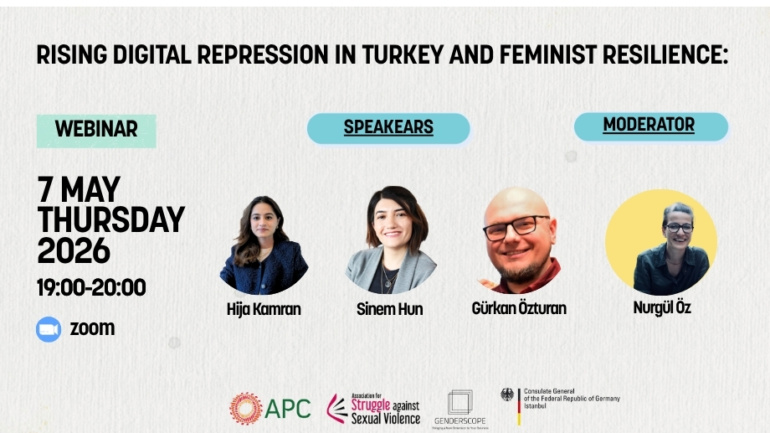


The webinar “Rising Digital Repression and Feminist Resilience in Türkiye: GisWatch 2026 Türkiye Special Issue,” organized through the collaboration of the Association for Struggle Against Sexual Violence (CŞMD), the Association for Progressive Communications (APC), and Genderscope, on May 7, opened up a comprehensive space for discussion on digital rights, censorship, feminist resistance, and struggles against technology-facilitated gender-based violence in Türkiye. Held with the support of the German Consulate General in Istanbul, the event presented for the first time the key findings of the GisWatch 2026 Türkiye Special Issue report, which is planned to be published in August. The webinar also explored the new forms of solidarity developed by feminists, LGBTQI+ communities, journalists, human rights defenders, and independent media workers in response to intensifying digital repression in Türkiye.
Digital Space: A Ground for Struggle and Solidarity
Moderated by Nurgül Öz from CŞMD, the webinar emphasized that digital spaces are not merely communication platforms for feminist movements but also political arenas where censorship, surveillance, online violence, and resistance practices intersect. It was highlighted that technology-facilitated gender-based violence (TFGBV) is less a new form of violence than the digital reproduction of existing patriarchal mechanisms of oppression. Öz stressed that digital spaces are not neutral environments, stating: “Gender-based violence carried out through technology is not new; it is the continuation of censorship, surveillance, harassment, and oppression in digital spaces.”
Hija Kamran: “Digital Violence Targets Women and LGBTQI+s”
The first speaker of the event, APC Women’s Rights Programme Advocacy Strategy Specialist and Editor Hija Kamran, underlined that technology-facilitated violence cannot be understood solely as individual attacks. According to Kamran, digital violence emerges at the intersection of state censorship policies, the algorithmic preferences of technology companies, and broader climates of social hatred.
In her speech, Kamran stated, “Violence occurs not only because of what people say, but because of who they are,” emphasizing that women and LGBTQI+s are systematically targeted in digital spaces. She also highlighted how APC contributes to global feminist knowledge production and policy advocacy through initiatives such as the Feminist Internet Research Network, Safety for Voices, and Global Information Society Watch (GISWatch).
Kamran stressed that online and offline violence cannot be considered separately, recalling recent cases in which acts of sexual violence committed physically were circulated digitally and reached millions of people. “Digital systems amplify existing violence, make it permanent, and carry it across borders,” Kamran said, adding that platforms have become not only communication tools but also political spaces where violence is reproduced.
Sinem Hun: “Civil Society Became Digitalized, but Repression Became Digitalized Too”
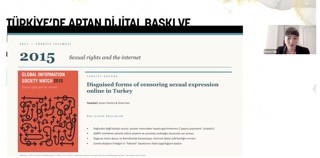
Speaking in the second part of the webinar, Sinem Hun, a human rights lawyer and founder of Genderscope, provided a comprehensive evaluation of how digital repression in Türkiye has transformed over time, drawing on the GISWatch Türkiye reports she has co-authored with Gürkan Özturan since 2014. Presenting the findings of their monitoring year by year, Hun walked through each report in turn, noting that this 12-year body of work effectively documents the systematic narrowing of internet freedoms in Türkiye.
According to Hun, the process that began in 2014 with communication surveillance and internet bans evolved into a new phase during the State of Emergency period, characterized by increasing control mechanisms, algorithmic censorship, AI-supported content moderation, social media laws, and platform dependency. “In every period, a new form of censorship emerged,” Hun stated, describing the development of a multilayered repression mechanism extending from direct access bans to algorithmic invisibilization.
One of the most important points highlighted by Hun was the digitalization of civil society. She explained that after the Gezi protests, feminist movements, LGBTQI+ organizations, and ecological activists began using digital spaces strategically, and that this transformation accelerated during the pandemic. However, this digitalization process also brought intensified surveillance, data tracking, and platform dependency.
Hun emphasized that feminist movements, LGBTQI+ organizations, and ecological activists increasingly relied on digital spaces after Gezi, and that the pandemic deepened this shift even further. Yet this process simultaneously produced heavier surveillance, data monitoring, and dependence on digital platforms. By stating, “Civil society became digitalized, but repression became digitalized too,” she drew attention to the dual nature of digital spaces.
Gürkan Özturan: “Algorithmic Censorship and Digital Surveillance”
The final speaker of the webinar, Gürkan Özturan, who has been the country rapporteur for the GiSWatch since 2017, shared the key findings of the 2026 Türkiye report titled “Resistance and Resilience Against Repression.” Özturan recalled that Türkiye has long been categorized by Freedom House as a “not free” country and argued that pressure on digital spaces has now spread into all areas of daily life.
According to Özturan, Law No. 5651 has gradually evolved from a regulation concerning the internet into a comprehensive surveillance and control mechanism. He pointed out that through data localization policies, obligations imposed on social media platforms to appoint representatives, data-sharing requirements, and content removal requests, digital spaces have come under intense control.
Özturan particularly emphasized algorithmic censorship, arguing that repression can no longer be attributed only to state censorship, but also to the economic and political preferences of platforms themselves. He explained that X’s (Twitter’s) algorithm changes, Google’s policies that render independent media invisible, and paid visibility systems have especially weakened independent media outlets and human rights defenders.
Özturan also noted that organized troll attacks based on misogyny and anti-LGBTQI+ hostility have become systematic. He stated that activists, especially after the March 8 demonstrations and Pride Marches, have increasingly been targeted through doxxing, death threats, and sexually explicit attacks.
Resilience, Collective Memory, and Struggle
Throughout the webinar, discussions focused not only on repression but also on the resilience and resistance practices developed by feminist and queer movements. Participants emphasized that digital spaces are not merely defensive arenas but also spaces for memory production, visibility, solidarity, and international networking.
The Monument Counter for Femicide, campaigns around the Istanbul Convention, and psychosocial support networks established after the 6 February earthquakes were highlighted as important examples of digital feminist solidarity. It was especially noted that digital campaigns during the withdrawal from the Istanbul Convention significantly increased public awareness of the Convention.
Participants also emphasized that both global and local movements have much to learn from one another, and suggested that solidarity networks should be imagined not only locally but internationally. Building solidarity networks in a two-way relationship between the global and the local, disseminating successful local practices, adapting international good practices to local contexts, and expanding models such as psychosocial support networks were all underlined as essential strategies.
Joint Call: Safe and Free Digital Spaces
At the conclusion of the webinar, participants called for resistance against repressive internet laws, Türkiye’s return to the Istanbul Convention, the expansion of digital security and digital/legal literacy trainings, increased access to safe digital tools, and the strengthening of international feminist solidarity networks.
The 2026 Türkiye report will be published in both English and Turkish on APC’s website in June. You can access previous GisWatch Türkiye reports here.